7-day western Bhutan
- Days 1-2: Paro valley and Rinpung Dzong, then on to Thimphu.
- Day 3: Thimphu markets, crafts and Buddha Dordenma.
- Days 4-5: Dochula Pass and the Punakha valley.
- Days 6-7: Return to Paro and hike to Tiger's Nest.

Asia, 15 places, Best March to May and September to November
Himalayan valleys, fortress monasteries and a kingdom that limits its visitors on purpose.
 By Norter editorial desk, updated 12 November 2026
A small Buddhist kingdom between India and China, where forest still covers most of the land and dzongs remain working seats of government and monastic life.
Bhutan is one of the few places in the Himalaya where the old way of building, dressing and worshipping is still ordinary daily life. Dzongs, the great white fortress monasteries, are in use as district offices and monk bodies. National dress is worn to work and school. The country measures itself partly by Gross National Happiness, and its constitution requires that forest cover never falls below 60 percent.
Tourism is deliberately low volume. Most visitors fly into Paro, spend a few days in the western valleys, and leave wishing they had booked more nights.
A week gives you the classic western circuit: Paro, Thimphu, Punakha and, if you can spare the road time, Phobjikha. Ten to twelve days lets you cross the Pele La into central Bhutan and reach Trongsa and Bumthang. Eastern Bhutan needs two weeks or more, and rewards travellers who have already seen the west.
Roads are good but slow. Most of the country is folded mountain, so a journey that looks short on the map usually takes most of a day. Build in time for it.
Most international visitors pay a Sustainable Development Fee per night, on top of hotel, guide, vehicle and meal costs. It funds conservation, health and education. Rates differ for Indian, Bangladeshi and Maldivian nationals and for children, and they do change, so check the current figure with us or with the Department of Immigration before you budget.
Dress modestly at temples and dzongs: long sleeves and long trousers or skirts, with no hats. Walk clockwise around chortens and prayer wheels. Take off your shoes in temple rooms, and ask before photographing inside. Many inner shrines do not allow photography at all.
Chilli is treated as a vegetable here, not a seasoning. Try ema datshi (chilli and cheese), kewa datshi (potato and cheese), red rice, momos and suja, the salted butter tea. Hotels will usually tone down the heat for visitors. Ask for the real thing if you want it.
All visitors except nationals of India, Bangladesh and the Maldives need a visa approved before arrival. It is applied for online, and is usually handled by your tour operator or hotel. Indian, Bangladeshi and Maldivian nationals need an entry permit instead. Always confirm current rules with the Department of Immigration.
Paro is the international airport, served by Drukair and Bhutan Airlines from cities including Bangkok, Delhi, Kolkata, Kathmandu, Dhaka and Singapore. Overland entry is possible at Phuentsholing, Gelephu and Samdrup Jongkhar on the Indian border.
Jump straight to the experience you are planning.
The gateway valley: the international airport, Rinpung Dzong, willow-lined rice fields and the climb to Tiger's Nest.
The capital: a young, walkable city with weekend markets, craft schools and no traffic lights.
The old winter capital, warmer and lower, with the most beautiful dzong in the kingdom.
A wide, quiet glacial valley and the winter home of black-necked cranes.
Four high valleys of old temples, apple orchards, buckwheat and honey.
The largest dzong in the country, on a ridge above a deep gorge.
A hidden valley over the Chele La, opened to visitors only in 2002.
A ridge-top town rebuilt around its restored dzong, and the road junction for Phobjikha.
Hot springs, a dramatic dzong, and the trailhead country of the far north.
The start of the east, and the base for Lhuentse and its textile villages.
The busy hub of the east, close to Merak, Sakteng and Trashiyangtse.
Home to Chorten Kora, and winter roost of black-necked cranes in Bumdeling.
The busy southern gateway on the Indian border, and the overland entry for many travellers.
The southeastern exit to Assam, used for west-to-east traverses of the country.
Subtropical forest in the south, with rich birdlife and wildlife.
The sights most worth planning around.
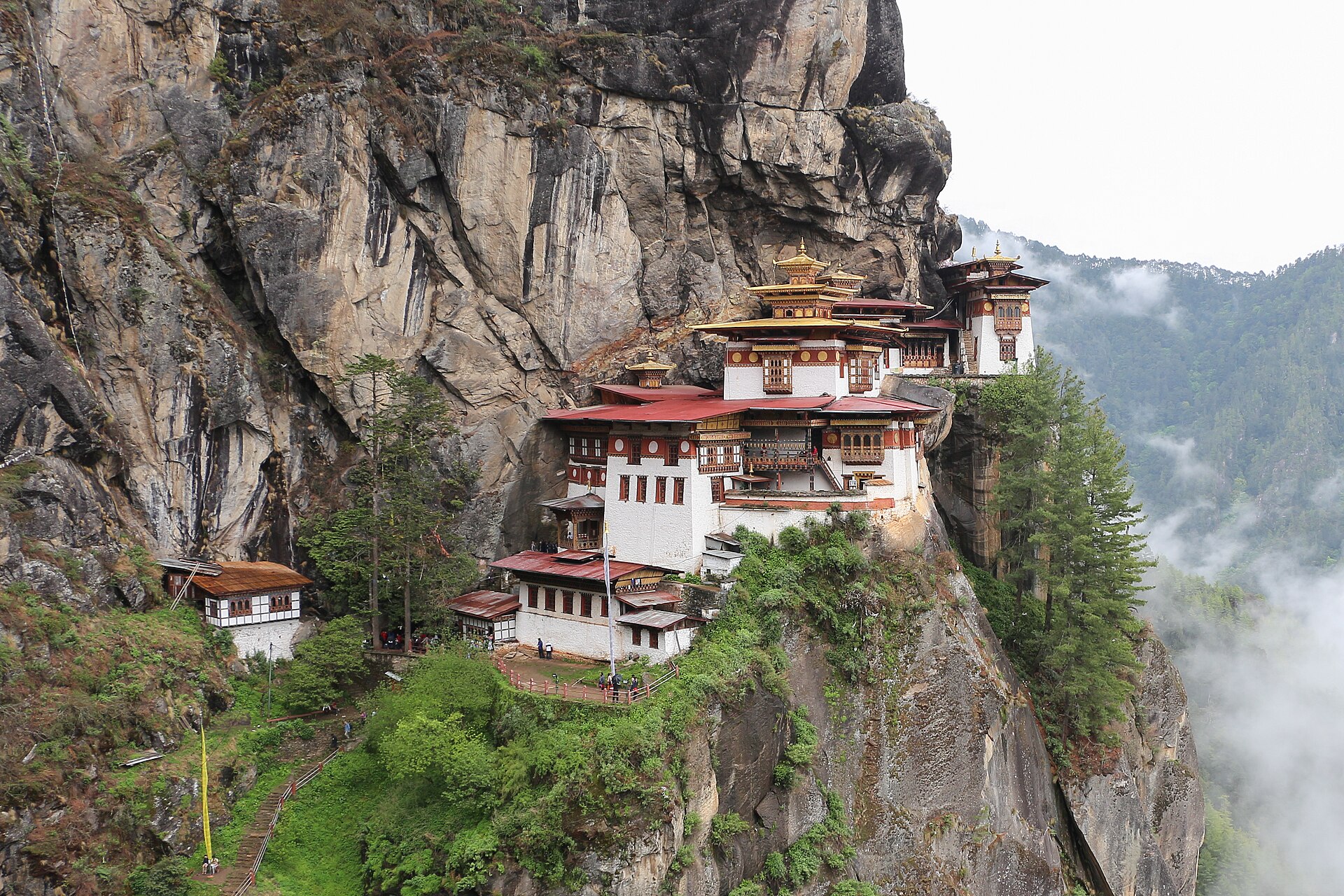
The cliff-face monastery that has become the image of Bhutan, reached by a steep half-day hike.
A 3,100-metre pass on the Thimphu to Punakha road with memorial chortens and winter views of the Himalaya.
A vast, elegant dzong at the meeting of two rivers, and the winter home of the central monk body.
The most important Nyingma monastery in western Bhutan, overlooking Phobjikha.
The fortress above Paro town and the setting of the Paro Tshechu.
The seat of the government and the central monk body, on the Thimphu river.
A vast gilded Buddha on Kuenselphodrang ridge, with views over the whole Thimphu valley.
A hillside reserve for the takin, the national animal of Bhutan.
The fertility temple of the Divine Madman, reached by a short walk through rice fields.
The classic Bhutan day hike: steep forest switchbacks, prayer flags and an astonishing final view.
Watch endangered cranes feed in the marshes of Phobjikha at dusk and dawn.
Bhutan's national sport, played with friendly heckling over astonishing distances.
Meet the weavers of Khoma, whose silk brocades can take many months to finish.
The biggest weekend market in Bhutan, with red rice, dried cheese, chillies and incense.
Walk the high passes when wild rhododendrons bloom across the slopes.
Routes you can use as they are, or ask us to adjust.
The classic first trip: Paro, Thimphu, Punakha and the hike to Tiger's Nest.
From US$2,450 10 days, natureAdds Phobjikha, Trongsa and Bumthang to the western classics, at an easy pace.
From US$3,400 8 days, trekkingA high ridge trek between Paro and Thimphu, past alpine lakes and old monasteries.
From US$2,900 12 days, trekkingOne of the great Himalayan treks, to the foot of the sacred peak on the Tibetan border.
From US$4,200 8 days, festivalTime your trip to the great spring festival, ending with the unfurling of the giant thongdrol.
From US$2,950 15 days, cultureCross the whole kingdom by road, from Paro to Samdrup Jongkhar.
From US$5,200Prices are a rough guide and change with the season.
Family-run tourist hotels with simple rooms and home-style meals.
Boutique hotels and resorts, often with valley views and traditional architecture.
International lodges with spas, private guides and most meals included.
A pine-forest retreat above the Paro valley, known for wellness and Bhutanese cooking.
View hotelA hand-built hotel in traditional Bhutanese style, with a temple inside.
View hotelA contemporary retreat high above Thimphu, one of a series of lodges across Bhutan.
View hotelA central city hotel, a short walk from Norzin Lam.
View hotelPlaces we would send a friend.
Traditional farmhouse cooking beside the Folk Heritage Museum.
Home-style dishes served in a traditional house on the southern edge of Thimphu.
A relaxed Norzin Lam cafe with good coffee and light meals.
A simple main-street favourite for local dishes and momos.
Most visitors travel with a licensed guide and a private vehicle and driver. Roads are good but winding, so 100 km can take three hours or more. Domestic flights link Paro with Bumthang and Yongphulla in the east, but schedules are limited and depend on the weather.
A rough guide to daily spending by level.
| Category | Budget | Mid-range | Luxury |
|---|---|---|---|
| Accommodation | US$60 to 120 | US$150 to 350 | US$800 and up |
| Food | US$20 to 30 | US$30 to 60 | Often included |
| Guide and vehicle | US$80 to 120 | US$80 to 120 | US$120 and up |
| Sustainable Development Fee | US$100 | US$100 | US$100 |
| Daily total per room or couple | About US$360 to 470 | About US$460 to 730 | US$1,120 and up |
Winter is cold but often clear, and it is the season for black-necked cranes in Phobjikha.
The most visited festival in the country, ending with a giant thongdrol shown at dawn.
September or OctoberA multi-day festival of masked dances in the courtyard at Tendrelthang, near Tashichho Dzong.
February or MarchDramatic re-enactments of 17th-century battles, followed by masked dances.
October or NovemberA famous Bumthang festival known for its fire ceremony and midnight dance.
Quieter places most travellers miss.
A cluster of small temples on a cliff above Bondey, sometimes called the little Tiger's Nest.
One of the oldest nunneries in Bhutan, clinging to the rock below the Chele La.
A historic fortress at the head of the Paro valley, built to mark a victory over Tibetan forces.
A small, very old dzong just south of the capital, and often overlooked.
A hillside temple where local parents bring newborn children for blessings.
A small workshop where you can watch traditional daphne paper being made.
Most visitors travel with a licensed guide, and one is needed for dzongs, temples and most areas beyond Thimphu and Paro.
Plan for about US$360 or more per day for two people sharing, including the Sustainable Development Fee, a guide, a vehicle, a hotel and meals.
March to May and September to November offer the best mix of weather, views and festivals.
Yes. Drukair and Bhutan Airlines fly to Paro from several Asian cities.
A guide to Afghanistan, including Band-e Amir, Minaret of Jam and Herat Citadel.
A guide to Armenia, including Geghard Monastery, Lake Sevan and Tatev Monastery.
A guide to Azerbaijan, including Baku Old City, Gobustan and Sheki Khan Palace.
A guide to Bangladesh, including Sundarbans, Cox's Bazar and Old Dhaka.